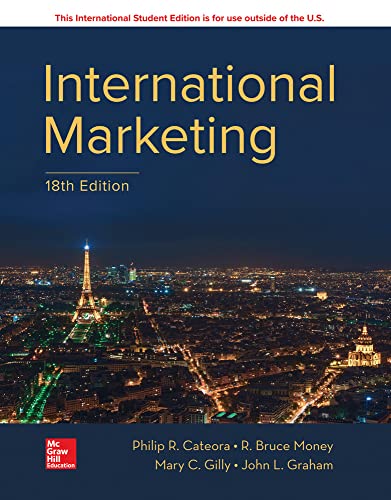
International marketing / Philip R. Cateora, Mary C. Gilly, John L. Graham.
Publication details: New York : McGraw-Hill Education, 2020. Edition: Eighteenth editionDescription: xxxii, 682 pages : illustrations (colour) ; 28 cmISBN:- 9781260547870
- 1260547876
- HF1416 .C359I
| ประเภททรัพยากร | ห้องสมุดที่อยู่ปัจจุบัน | หมวดหมู่ | ตำแหน่งจัดวาง | เลขเรียกหนังสือ | สถานะ | วันกำหนดส่ง | บาร์โค้ด | จำนวนรายการจอง |
|---|---|---|---|---|---|---|---|---|
 หนังสือ
|
PIM Creative Learning Space | หนังสือภาษาอังกฤษ | English Book Shelves | HF1416 .C359I 2020 (เรียกดูชั้นหนังสือ(เปิดด้านล่าง)) | ยืมหนังสือแล้ว | 18/05/2023 00:00 | 32550000505302 |
เรียกดูชั้นหนังสือของ PIM Creative Learning Space ปิดเครื่องมือเรียกดูชั้นหนังสือ (ซ่อนเครื่องมือเรียกดูชั้นหนังสือ)

|

|
|

|

|

|

|
||
| HF1416 .C359 2009 Guo ji shi chang ying xiao xue : yuan shu di 12 ban= International marketing/ | HF1416 .C359 2009 International marketing / | HF1416 .C359 2009 International marketing / | HF1416 .C359I 2020 International marketing / | HF1416 .C953 2004 International marketing | HF1416 .C998 The global marketing imperative / | HF1416 .G411 2006 International marketing / |
Includes indexes.
"At the start of the last millennium, the Chinese were the preeminent international traders. Although a truly global trading system would not evolve until some 500 years later, Chinese silk had been available in Europe since Roman times. At the start of the last century, the British military, merchants, and manufacturers dominated the seas and international commerce. Literally, the sun did not set on the British Empire. At the start of this century, the United States had surged past a faltering Japan to retake the lead in global commerce. The American domination of information technology has since been followed by the political upheaval of 9/11 and the economic shocks of 2001 and 2008. China started the 21st century as the largest military threat to the United States, and within a decade it had become a leading, often difficult trading partner. What surprises do the new decade, century, and millennium hold in store for all of us? In this century, natural disasters and wars hampered commerce and human progress. Just in the last decade, we have witnessed the human tragedy and economic disaster of a 1000-year earthquake and tsunami and a nuclear meltdown in Japan; protests and revolutions-- the so-called Arab Spring--across the Middle East and North Africa (MENA); widespread economic protests across the developed countries; and the ongoing potential for a financial meltdown in the European Union. The battle to balance economic growth and stewardship of the environment continues. The globalization of markets has certainly accelerated through almost universal acceptance of the democratic free enterprise model and new communication technologies, including cell phones and the Internet"-- Provided by publisher.


ไม่มีความคิดเห็นใด ๆ ต่อชื่อเรื่องนี้